 StaffGenerator
Interview scorecard from a job description
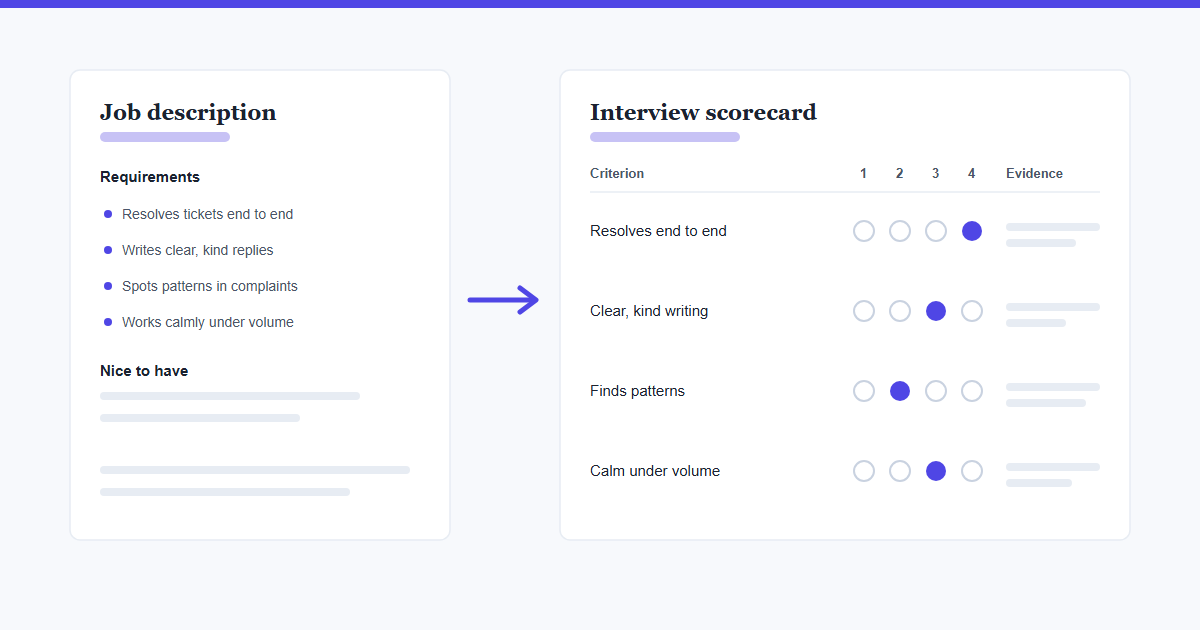
An interview scorecard is the job description turned into something you can grade: a short list of criteria taken from the role’s requirements, a rating scale with the ends spelled out, and space for the evidence behind each rating. Built from the job description, it makes every interviewer judge the same things, and it turns the debrief from “I liked her” into “here is what we saw”.
This guide shows how to build one in under an hour, with a worked example for a customer support role you can copy.
1. Start from the requirements, not from the interview
Open the job description and read the responsibilities and requirements. Each requirement that truly decides whether someone can do the job becomes one criterion on the scorecard. If you wrote the job description well, this step is almost mechanical; if you cannot turn a requirement into something you could observe in an interview, that is a sign the requirement is vague, and worth fixing in the advert too.
Keep it to four to six criteria. More than that and interviewers skim; fewer and you end up judging the whole person on one impression. Nice-to-haves can sit at the bottom as a separate, unscored note, so they break ties without deciding the hire.
2. Write each criterion as something you can see
“Good communicator” cannot be scored; two interviewers will mean two different things by it. “Explains a technical trade-off to a non-specialist in plain words” can. Rewrite each criterion until an interviewer could point to the moment in the conversation that earned the rating.
The same goes for seniority. A junior and a senior version of the same role share criteria but expect different evidence; our guide to junior versus senior job descriptions covers how the expectations change with scope.
3. Choose a scale and anchor both ends
A four-point scale works well: 1 (clear concern), 2 (some concern), 3 (meets the bar), 4 (strong). An even number of points removes the safe middle score, so every interviewer has to lean one way.
Then write one sentence for what a 4 looks like and one for what a 1 looks like, for every criterion. These anchors are what make two interviewers’ scores comparable. Without them, one person’s 3 is another’s 4.
4. Give every criterion its questions and its owner
Assign each criterion to one interviewer, two or three criteria each, so nobody asks the same thing twice and nothing is left unasked. Write the questions in advance and ask every candidate the same ones.
- Past behaviour. “Tell me about a time a customer was angry about something you could not fix. What did you do?” Ask follow-ups until you hear what they did, not what the team did.
- Work samples. A short, realistic task, such as answering a real (anonymised) ticket, shows the skill directly. Keep it short and do not ask for unpaid work that you would use.
- Situations. “What would you do if…” questions help for juniors with little history, but rate the reasoning, not the right answer.
5. Score alone, before anyone talks
Each interviewer fills in their ratings and the evidence straight after the interview, before speaking to anyone else. The evidence column matters most: a quote or a specific example the candidate gave. A score with no evidence is an impression, and the first strong opinion in the room tends to pull everyone else toward it.
6. Run the debrief by criterion
Go through the scorecard one criterion at a time and let each interviewer read their score and evidence. Disagreements are useful: they show where the anchors were unclear or where one interviewer saw something the others did not. Decide the bar before the first interview, for example “at least a 3 on every must-have”, so the decision is not renegotiated for each candidate.
A worked example: customer support specialist
Four requirements from the job description, turned into criteria with their anchors:
| Criterion | From the job description | A 4 looks like | A 1 looks like |
|---|---|---|---|
| Resolves a ticket end to end | Own customer issues from first reply to resolution | Walks through a messy case, names who they pulled in and how they confirmed it was fixed | Describes passing the problem on and not knowing the outcome |
| Clear, kind writing | Write clear, friendly replies in the customer's tone | Work-sample reply is short, answers the question first, and stays warm with an angry customer | Reply is long, repeats policy and never answers the question |
| Spots patterns | Flag recurring issues to the product team | Gives an example of a trend they noticed, raised, and saw fixed | Treats every ticket as separate; no example of escalating a pattern |
| Calm under volume | Handle busy periods without losing quality | Describes a concrete method for a backlog, such as triage by impact, and what they dropped on purpose | Only says they work harder or longer |
Two interviewers cover it: the team lead takes “resolves end to end” and “spots patterns”, a senior agent runs the written work sample and “calm under volume”. The bar is a 3 or better on all four.
Keep the scorecards, carefully
Completed scorecards are your record of why a hire was made, which helps if a decision is ever questioned and when you review whether the criteria predicted good hires. In the EU they are also personal data about the candidate: write evidence as if the candidate might read it, and keep scorecards only as long as your retention policy says. If you need to show later which version of a scorecard was used for a hiring round, a sealing service such as XSeal can timestamp the template so you can prove it was not changed afterwards.
Scorecards also shorten hiring: decisions come faster when the evidence is already written down. Our breakdown of where time to hire goes shows how much of the delay sits in debriefs and decisions.
Start from a clear job description
A scorecard is only as good as the requirements it comes from. StaffGenerator writes the job description for a role with its responsibilities, requirements and nice-to-haves already separated, which is exactly the input a scorecard needs, along with an onboarding checklist and an HR policy. For the job description itself, see how to write a job description, section by section.