 StaffGenerator
How to write a job description, section by section
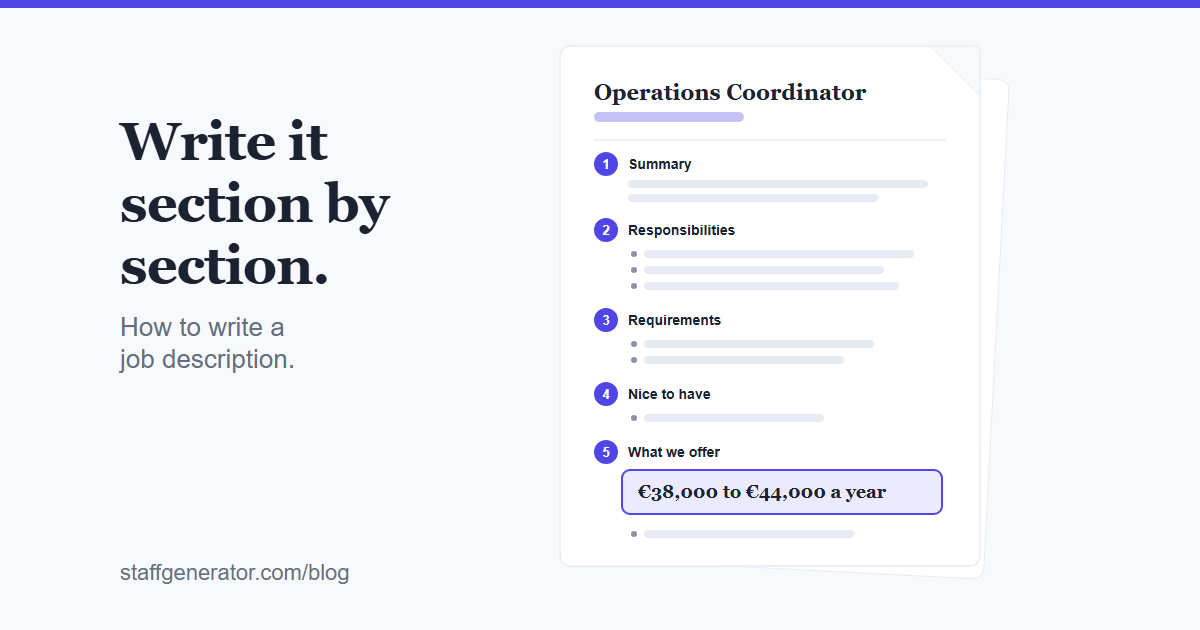
Most job descriptions are written in a hurry, the night before a vacancy goes live, by copying the last one and changing the title. The result reads like every other ad on the job board, attracts people who apply to everything, and puts off the person you actually wanted. Knowing how to write a job description well is less about writing talent than about answering a few questions in the right order.
A job description does three jobs at once. It sells the role to people who are not looking hard. It filters, so that the people who apply are the ones who could do the work. And after the hire it becomes the reference point for what the role is for, which matters at the first review and every one after it. This guide walks through each section in the order a reader meets it, with a short example you can adapt and a checklist to run before you publish.
Before you write: four questions to answer
Ten minutes with the hiring manager before anyone writes a word saves hours of rewriting later. Get written answers to these four:
- Why does this role exist now? A replacement, growth, a new service, a gap someone is covering on top of their own job. The answer shapes the summary.
- What does success look like after six months? Two or three concrete outcomes. These become your responsibilities, and later the first review.
- What is truly required on day one, and what can be learned? Be strict. Every requirement you add removes candidates, so each one needs a reason.
- What does the role pay? Agree the range before writing, not after the first interview. In the EU it is becoming a legal duty to tell applicants; our guide to EU pay transparency for job ads covers what changes.
1. The job title
The title is what candidates search for and what a job board matches on, so use the words people in the role would use to describe themselves. “Operations Coordinator” finds operations coordinators; “Logistics Hero” finds nobody. Leave internal grades and team names out of the title, put the seniority in plainly (junior, senior, lead) when it matters, and keep it gender-neutral in every language you publish in.
2. The summary
Two or three sentences that tell the reader what the team does, why the role matters and what they would own. This is the part most people read before deciding whether to read the rest, so lead with the work, not the company history. A useful test: could a friend of the candidate explain the job back to them from the summary alone?
3. Responsibilities
Five to eight bullets, written as outcomes the person will own rather than tasks they will be handed. Start each one with a verb, put the most important one first and say how often the bigger ones happen. “Plan next-day delivery routes for 30 drivers, every afternoon” tells a candidate far more than “Responsible for route planning”. Avoid “other duties as assigned” as a bullet: everyone knows jobs change, and the line only makes the rest look less considered.
4. Requirements
This is where most job descriptions lose good people. List only what someone genuinely needs on the first day, and describe skills rather than proxies for them. “Three years of experience” is a guess at a skill level; “comfortable building a weekly schedule in a spreadsheet” is the skill itself. Degree requirements, exact years and long tool lists each shrink the pool, and they tend to shrink it unevenly, because some applicants only apply when they meet every line. If you would hire someone who lacked an item, it is not a requirement. We cover the most common traps in job description mistakes that quietly filter out great candidates.
5. Nice to have
Keep this short: three or four items at most, and only ones that would genuinely help. A separate “nice to have” list is useful precisely because it gives you somewhere to put the wish list without turning it into a wall of requirements. If the list grows past four, some of those items are really requirements in disguise, and the role needs another conversation with the hiring manager.
6. What we offer
Pay first, as a concrete range per year, month or hour, followed by the things a candidate will weigh against their current job: hours, location or remote pattern, contract type, holidays and the benefits you actually provide. Skip “competitive salary” and “great culture”; they say nothing and every ad uses them. One specific detail, such as a fixed training budget or a four-day week in summer, does more than a list of adjectives.
7. How to apply and what happens next
Tell people what to send, who will read it and how long each step takes. “We reply to every application within five working days; there are two interviews, the second with the team” sets expectations you can be held to, which is exactly why it builds trust. If you ask for a cover letter or a test task, say why.
A short example
Here is how those sections fit together for an operations coordinator at a regional delivery company:
Operations Coordinator (full time, Utrecht)
We deliver groceries for 40 local shops across the Utrecht region. You will run the daily planning that gets 30 drivers on the road on time, and be the person shops and drivers call when something changes.
You will: plan next-day routes every afternoon; rebalance routes when a driver calls in sick; keep shops updated on late deliveries; report weekly on on-time delivery and fix what slows it down.
You need: confidence planning in a spreadsheet; calm, clear communication by phone; Dutch and English.
Nice to have: experience with route planning software; a driving licence.
We offer: €38,000 to €44,000 a year; 38 hours, Monday to Friday, 08:00 to 16:30; 25 holiday days; travel costs paid.
Notice what is missing: no years of experience, no degree, no “fast-paced environment”. Every line either describes the work or answers a question the candidate would otherwise have to ask.
A checklist before you publish
- The title uses the words candidates search for, with seniority where it matters.
- The summary explains the work and why it matters in three sentences or fewer.
- Responsibilities are outcomes, most important first, without a catch-all line.
- Every requirement is needed on day one; everything else is in nice to have or removed.
- The ad shows a real pay range and the conditions people compare.
- The process and timeline are stated, and you can keep to them.
- Someone who does a similar job has read it and recognised the role.
Keep the description alive after the hire
Once the role is filled, the job description becomes the basis for the first weeks. Turn the responsibilities into the goals in your 30-60-90 day onboarding plan, and revisit the description at the first review: roles drift, and a description that still matches the work makes the next hire much faster. If you need to prove later what a role was advertised as, or how it changed, keep each version on record; a sealing service like XSeal can timestamp each revision as a new version of the same document, so the history is easy to show.
Start from a draft, not a blank page
StaffGenerator drafts a job description in exactly this structure, summary, responsibilities, requirements, nice to have and what we offer, from a job title, industry and seniority, together with an onboarding checklist and an HR policy for the role. Add your company name and the role’s pay range and they are written into the draft. Everything stays editable, so the draft gives you the shape and you add what only you know: why the role exists now and what success looks like.