 StaffGenerator
The 30-60-90 day onboarding checklist new hires actually use
A new hire’s first week decides more than most managers realise. Someone who spends day one waiting for laptop access and asking three different people how the team’s Slack is organised quietly recalibrates their expectations of the whole company, right when their optimism is at its highest. A good 30-60-90 day onboarding checklist is not paperwork for its own sake: it is the difference between a new hire who is contributing real work by week three and one who is still guessing at week eight.
Most onboarding checklists fail for one of two reasons: they list tasks (“set up laptop”, “complete HR forms”) with no sense of sequencing or ownership, or they are so generic they could describe onboarding at any company for any role. Here is a structure that avoids both, organised around the three horizons that actually matter: the first 30 days, the next 30, and the 30 after that.
Why 30-60-90 beats a flat task list
A flat checklist treats every task as equally urgent and equally important, which is never true. Signing an NDA on day one matters more than mastering the deployment pipeline on day one; the reverse is true by week ten. Organising onboarding around three time horizons instead forces a real decision about sequence: what does this person need to function this week, what do they need to start contributing meaningfully, and what does full ownership of their role actually look like. That decision is where most of the real value of an onboarding plan lives, and a flat list skips it entirely.
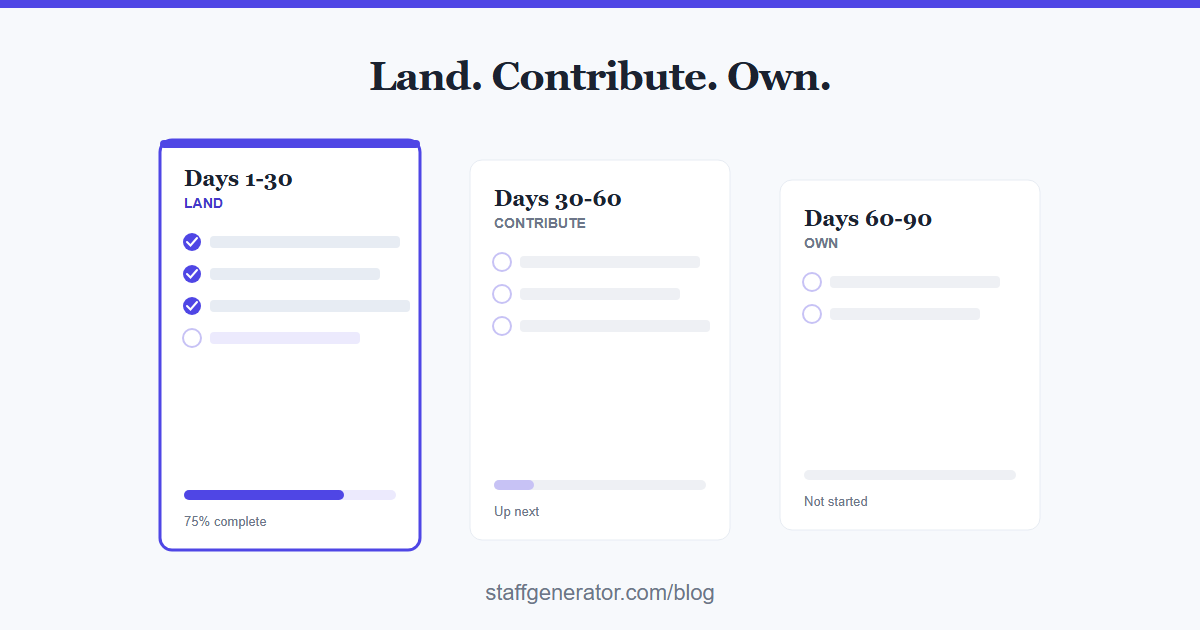
Days 1-30: land
The first horizon is about removing friction and building context, not producing output. A new hire who spends their first month asking around for basic access or context is not being tested, they are being wasted.
What belongs here
- All accounts, tools, and physical or remote access working before day one, not requested on day one
- A named onboarding buddy, distinct from their manager, for the questions people feel silly asking a boss
- Structured introductions to the people they will actually work with, not a company-wide all-hands
- A clear, written explanation of what their role actually covers and does not cover
- One small, real, low-risk task completed and shipped in the first week, so they experience contributing early
The single most common failure at this stage is treating “day one” as the start of setup instead of the end of it. Everything logistical should be finished before the new hire’s first morning, so their actual first days can be spent on context and people, not tickets and passwords.
Days 30-60: contribute
The second horizon shifts from absorbing context to producing real work, with support still close by. This is where a lot of onboarding plans go quiet, on the assumption that the new hire is now “up to speed” and can be left to figure out the rest.
What belongs here
- A real piece of work with visible impact, sized to be achievable without full context of everything
- Regular, scheduled check-ins with their manager, not just an open-door policy that requires the new hire to initiate
- Explicit feedback on what is going well and what needs to change, given proactively rather than waited for
- Shadowing or pairing on the parts of the role they have not touched yet
The goal by the end of this horizon is not mastery. It is that the new hire has done real, visible work and received real, specific feedback on it, so neither side is operating on assumptions going into the final stretch.
Days 60-90: own
The final horizon is about full ownership of the role as it was actually described when they were hired, plus a real look back at how the first three months went.
What belongs here
- Full ownership of their remit, with the training wheels from the earlier phases removed
- Clear, specific goals for the next quarter, agreed together rather than handed down
- A genuine 90-day review: what went well, what was harder than expected, what the company could have done better
- A decision point: is this role, as it actually turned out to be, still the right fit on both sides
That last point matters more than it is usually given credit for. A 90-day review that only asks “how is the new hire doing” misses half the point; the honest version also asks whether the role and the company are living up to what was promised in the interview.
Give it an owner, not just a template
A checklist without an owner decays the same way an unowned document does: it survives the first few hires because someone remembers to run through it, then quietly stops being used once that person moves on or gets busy. Assign one person, usually the hiring manager or an ops lead, as the actual owner of the onboarding checklist itself, responsible for updating it every time a new hire’s experience reveals a gap. The checklist should get better with every hire, not just get followed.
Once a role’s 90-day plan and final sign-off are finalised, it is worth keeping a tamper-evident record of exactly what was agreed, especially if goals or compensation changes were part of the conversation. A service like XSeal can seal that final sign-off document with a timestamped certificate, so there is never a dispute later about which version both sides actually agreed to.
Build the checklist once, reuse it for every role
Writing a genuinely structured 30-60-90 day plan from scratch for every new role is exactly the kind of detail-heavy work that quietly gets skipped under hiring pressure, which is how onboarding ends up reverting to “here’s your laptop, good luck.” StaffGenerator generates a real, ready-to- adapt onboarding checklist alongside every job description and HR policy, structured around the same first-30-days horizon this article describes, tailored to the actual role and industry you enter rather than a generic template. You edit it before you use it, so the specifics are always right, but the structure is never something you have to invent from a blank page again.