 StaffGenerator
EU pay transparency: what job ads must show
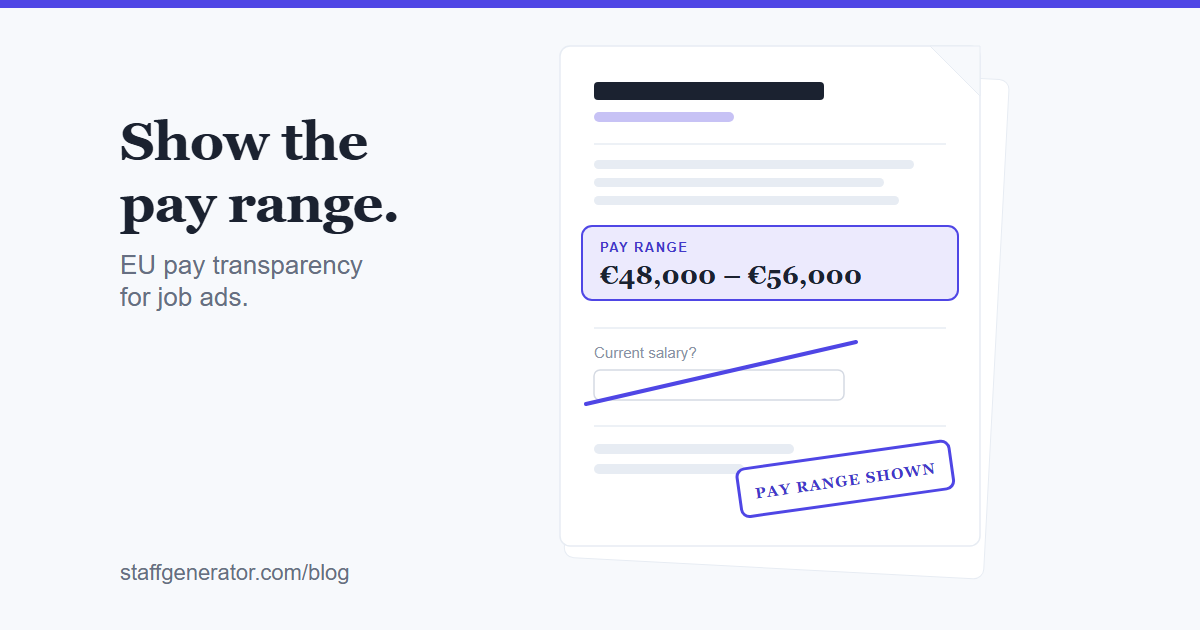
For years, “competitive salary” was the safest line in a job ad. It promised something, committed to nothing, and let the conversation about money wait until the final interview. In the European Union that line is on its way out. The Pay Transparency Directive makes the starting pay, or a range for it, something an applicant is entitled to know before they sit down for an interview, and it changes several other things about how you write and run a vacancy.
This guide covers what the directive actually requires of a job ad, what follows once someone is hired, how to set a range you can defend, and a checklist you can run against your current templates. It is a practical summary, not legal advice: the rules reach you through your own country’s law, and the details of that law are what you will ultimately be held to.
What the directive is, and why the timing is messy
Directive (EU) 2023/970 was adopted in 2023 to close the gender pay gap by making pay visible. Like every directive, it does not bind employers directly. Each member state has to write it into national law, and the deadline for doing so was 7 June 2026. Most countries missed it. By the late summer of 2026 only a handful, among them Italy, Malta, Lithuania and Slovakia, had fully transposed it, several others had transposed parts, and many were still consulting on drafts. The Netherlands, for example, has been working towards 1 January 2027, and Germany has signalled 2027 as well.
It is tempting to read that as a reason to wait. It is not a good one. The content of the rules is fixed by the directive, so national laws can add detail but cannot water down the core duties. The ads you write in the next few months will be live, or reused as templates, when your country’s law lands. And changing how a team writes and approves vacancies takes longer than changing a single document.
The four rules that touch your job ads
Article 5 of the directive covers the period before employment. It applies to every employer regardless of size, which makes it the part a ten-person company is most likely to trip over.
1. Give the starting pay or a range before the interview
Applicants have a right to information about the initial pay for the position, or its range, based on objective, gender-neutral criteria. The directive’s own example of how to provide it is the published vacancy notice, ahead of the interview; it also allows other ways, as long as the applicant gets the information in time for an informed, transparent negotiation. In practice, putting the range in the ad is the simplest way to prove you met the duty, and it is what candidates increasingly expect anyway.
2. Stop asking about salary history
Employers may no longer ask applicants about their pay in current or previous jobs. That reaches further than the obvious interview question. Check your application form, your applicant tracking system’s default fields and any screening scripts your recruiters or agencies use. A required “current salary” box on a form is the most common way a well-meaning company breaks this rule without anyone noticing.
3. Use gender-neutral titles and wording
Vacancy notices and job titles must be gender-neutral, and the recruitment process must be non-discriminatory. In English this is mostly about avoiding titles like “salesman” or “chairman” and gendered language in the body. In languages with gendered job nouns it takes more care: German ads already commonly add “(m/w/d)”, and Dutch, French and Spanish ads use neutral forms or both forms. Check what your national law accepts rather than assuming the local habit is enough.
4. Mention collective agreement terms where they apply
Where you apply a collective agreement to the role, applicants are also entitled to the relevant provisions of it. If your pay comes from a sector agreement scale, name the agreement and the scale or grade in the ad.
What follows once someone is hired
The job ad is the start of the story. The rest of the directive governs how pay works inside your company, and it is worth knowing the shape of it before you commit to a range, because the range you publish becomes evidence of how you set pay. The main duties, with the article each comes from:
| Duty | Who it applies to | When |
|---|---|---|
| Give applicants the starting pay or its range before the interview (Art. 5) | Every employer, any size | Once national law is in force |
| Never ask applicants about their pay history (Art. 5) | Every employer, any size | Once national law is in force |
| Gender-neutral vacancy notices and job titles (Art. 5) | Every employer, any size | Once national law is in force |
| Make the criteria behind pay and pay progression accessible to staff (Art. 6) | Every employer; countries may exempt under 50 workers from the progression part | Once national law is in force |
| Answer a worker's written request about pay levels within two months, and remind staff of this right every year (Art. 7) | Every employer, any size | Once national law is in force |
| Report the gender pay gap (Art. 9) | 250+ workers: yearly. 150 to 249: every three years. 100 to 149: every three years | First reports by 7 June 2027 (100 to 149: by 7 June 2031) |
| Joint pay assessment with worker representatives (Art. 10) | Reporting employers with an unexplained gap of 5% or more in a category, not fixed within six months | After a report shows the gap |
Two more points matter for small teams. Contract clauses that stop people from disclosing their own pay can no longer be used to prevent disclosure for equal-pay purposes, so pay secrecy is not a strategy. And in an equal-pay dispute, once a worker shows facts from which discrimination can be presumed, it is up to the employer to prove there was none (Article 18). Records of how you set each range are what make that proof possible.
Setting a range you can defend
A pay range in an ad is only useful if it is honest. A range of €30,000 to €90,000 tells an applicant nothing and invites exactly the questions you do not want. A defensible range comes from the role, not the candidate:
- Start from the work. The directive points to skills, effort, responsibility and working conditions as the objective criteria for comparing roles (Article 4). Write down which of those drive this role’s level.
- Anchor it to people already doing similar work. If a new hire would land above current staff in the same role, fix that first; the right-to-information rules mean the gap will surface.
- Keep the spread realistic. The bottom should be a real offer for someone who meets the requirements, and the top should be reachable without a title change.
- Record the reasoning. A short note per role on how the range was set is cheap now and hard to reconstruct during a dispute later.
Keep a dated copy of each ad exactly as it was published, too. If a question about what an applicant was told ever comes up, a tamper-evident record settles it quickly. A sealing service such as XSeal timestamps the final file so nobody can argue later about which version of the vacancy went live.
A job ad checklist for pay transparency
Run every open vacancy and every template through these steps before it is published:
- The ad states the starting pay or a concrete range, not “competitive” or “depending on experience”.
- The range is written down with the criteria behind it, and fits what current staff in similar roles earn.
- The job title and body are gender-neutral in every language the ad is published in.
- Application forms, ATS fields and screening scripts contain no salary-history question.
- If a collective agreement applies, the ad names it and the relevant scale or grade.
- A dated copy of the published ad is stored where you can find it in two years.
Fix the template once, not every ad
The quickest way to comply consistently is to change the documents everyone copies from, rather than relying on each hiring manager to remember the rules. If you already keep a standard job description template, add a required pay range line and a neutral-title check to it; our guide to standardising HR documents covers how to give those templates an owner and a review cycle. The compensation section is also the one we flagged in job description mistakes that filter out great candidates, and the directive turns that advice into an obligation.
StaffGenerator drafts the job description, onboarding checklist and HR policy for a role from its title, industry and seniority. Enter the role’s range in the generator’s optional pay range fields and it replaces the generic salary line in “What we offer”, written out in the pack’s language, per year, month or hour. Keep your company’s real benefits in your company profile so they appear in every pack automatically, and every field stays editable before you save or export. The draft gives you the structure; the range has to come from you, because only you know what the role pays.