 StaffGenerator
Where time-to-hire actually goes and how to shorten it
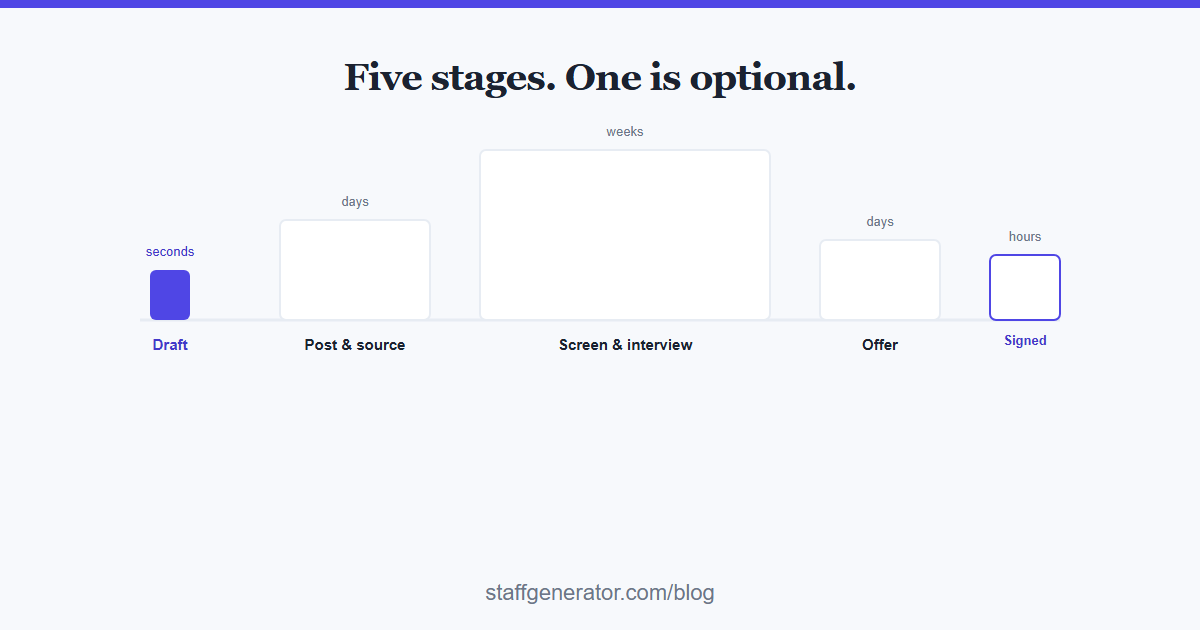
Time-to-hire gets reported as a single number, usually somewhere between three and eight weeks depending on the role, and treated as one thing to optimise. It is not one thing. It is five distinct stages stitched together, each with its own bottleneck, its own owner, and its own reason for taking as long as it does. Trying to “reduce time-to-hire” without knowing which stage is actually slow is how teams end up speeding up the one part that was never the problem.
Here is where the clock actually goes, stage by stage, and which parts a hiring team can genuinely shrink without cutting corners on the hire itself.
The five stages, and who actually controls each one
Every hiring process, regardless of company size, moves through the same five stages. What differs is how long each one takes and who has the power to speed it up.
1. Drafting the role
Writing the job description, the internal scorecard, and often an onboarding plan and a policy update to go with it. Controlled entirely by the hiring manager or recruiter, with no external dependency, which makes it the single easiest stage to compress: nothing about this stage requires anyone else’s calendar to be free.
2. Posting and sourcing
Getting the role live and generating a real applicant pool, either through inbound applications or active sourcing. Controlled by the recruiter and the job boards or channels used, and is where genuine external waiting begins: candidates apply on their own timeline, not yours.
3. Screening and interviews
Reviewing applicants, scheduling and running interview loops, and reaching a decision. Controlled jointly by the recruiter, the hiring manager, and every interviewer’s calendar, which is exactly why this stage is usually the longest: it depends on the availability of the most people.
4. Offer and negotiation
Extending the offer, negotiating terms, and reaching a verbal yes. Controlled by the hiring manager and whoever approves compensation, and often stalls on internal approval chains more than on the candidate.
5. Paperwork and signed offer
Generating the formal offer letter, getting it signed, and completing any required onboarding paperwork before a start date is confirmed. Controlled by HR or the hiring manager, and is frequently slower than it needs to be simply because the documents are being written from scratch under time pressure.
The stage almost every team over-optimises
When a company sets out to reduce time-to-hire, the instinct is almost always to speed up screening and interviews, because that is the stage that feels the slowest and the most visible. It is also usually the stage with the least room to compress without a real cost: cutting interview rounds or interviewer availability trades hiring quality for speed, which is rarely a trade worth making for a role you are about to spend a year or more depending on.
The stages with the most room to compress without any quality trade-off are the ones with no external dependency at all: drafting the role, and preparing the paperwork. Nobody’s calendar has to align for either of those to move fast. They are slow almost entirely because they are usually done from a blank page, under the same time pressure as everything else, by someone who is also managing the other four stages.
What actually shrinks the drafting and paperwork stages
Two changes compress these stages without touching interview quality or candidate experience at all.
Stop starting from a blank page
A job description, onboarding checklist, and HR policy written from scratch for every role is where a surprising amount of avoidable delay hides: waiting for a manager to find time to write it, a second round of edits because the first draft missed something, an approval cycle that only starts once a draft exists. Starting from a complete, role-specific first draft instead of nothing removes the waiting-to- start problem entirely. This is the exact gap StaffGenerator closes: enter a job title and industry and get a real, complete draft in seconds, not a template to fill in over a few days. See the docs for exactly how the drafts are generated and what you can edit before you use them.
Make the paperwork stage a formality, not a project
The same blank-page problem hits the offer letter and onboarding paperwork at the end of the process, usually written in a rush once a candidate has already said yes. Having a real, ready-to-adapt template on hand before you need it, rather than starting one the moment an offer is verbally accepted, turns a multi-day paperwork stage into a same-day one.
Once that final offer is signed, it is worth keeping a tamper-evident, timestamped record of exactly which version the candidate agreed to, especially if there was any negotiation along the way. A service like XSeal can seal the finalised offer letter with a verifiable certificate, so there is never a dispute later about which version was actually signed.
A practical way to audit your own time-to-hire
Before changing anything, measure the five stages separately rather than the total. For your last five hires, note:
- Days from role approval to job description finalised
- Days from job live to first qualified applicant
- Days from first applicant to final interview decision
- Days from decision to offer extended and accepted
- Days from verbal offer to signed offer and confirmed start date
Whichever stage is consistently the longest relative to the others is your real bottleneck, not the total number everyone quotes. If it turns out to be screening and interviews, the fix is genuinely about process and calendars. If it turns out to be drafting or paperwork, as it does for a lot of small and mid-size teams, the fix is far simpler: stop writing those documents from a blank page every time.
Shorten the part that was never about your candidates
Time-to-hire is not a single lever, and treating it like one usually means squeezing the stage that depends on other people’s time while ignoring the stage that depends on nobody’s but your own. Generate the job description, onboarding checklist, and HR policy for your next open role in seconds, and see how much of your own drafting time was actually the easiest thing on the list to fix. Check the pricing page if you are scaling this across a whole hiring team.