 StaffGenerator
Junior vs senior job description, explained
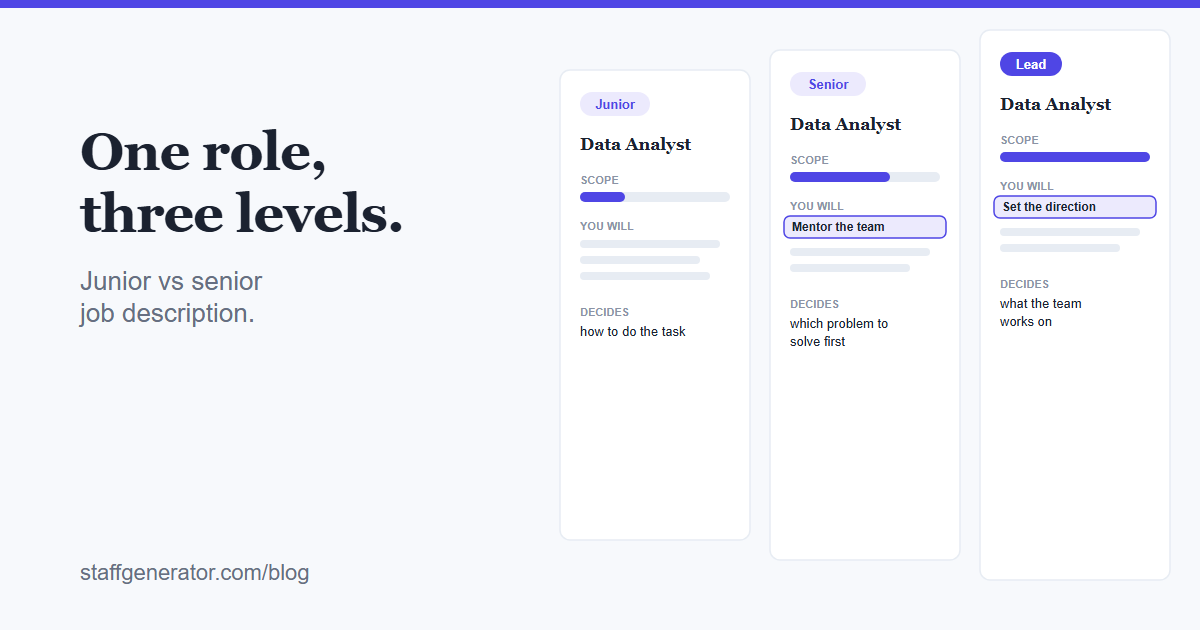
Most teams write a junior vs senior job description by taking one ad, swapping the word in the title and changing “2 years of experience” to “5 years”. Candidates notice. A senior person reads the ad and sees a junior job with a bigger number attached; a junior reads the senior version and cannot tell what would be expected of them. The difference between levels is real, but it is not in the title or the years.
This guide shows what should actually change when you write the same role at different levels, what can stay the same, and how to keep a family of related job descriptions consistent as you hire for more of them.
What really separates junior and senior roles
When managers describe the difference between a junior and a senior colleague, they rarely talk about years. They talk about four things, and those four are what the job description should show:
- Scope. A junior owns tasks; a senior owns an area; a lead owns the outcome for a team. “Build the weekly sales dashboard” is a junior responsibility. “Own reporting for the commercial team” is a senior one.
- Decisions. A junior decides how to do the work they are given. A senior decides which problem to work on first. A lead decides what the team works on at all.
- Ambiguity. Junior work arrives defined. Senior work arrives as a question, and part of the job is turning it into a plan.
- Other people. At senior level, raising the quality of other people’s work becomes part of the job: reviewing, mentoring, setting standards. At lead level, it becomes most of it.
If the junior and senior versions of your ad differ only in years, none of this is visible, and you will get applicants sorted by tenure instead of by the kind of work they are ready for.
What can stay the same
Plenty should not change between levels, and keeping it identical makes the family easier to maintain. The summary of what the team does, the tools and domain knowledge the role needs, the location and working pattern, the benefits and the hiring process are usually the same for every level. Write those once and reuse them. The structure should stay the same too, so a candidate comparing two of your ads can see at a glance what is different; our guide to writing a job description section by section covers that structure.
A junior vs senior job description, side by side
Here is one role, a data analyst in a retail business, written at three levels.
Junior Data Analyst. You will build and maintain the weekly sales and stock reports, answer well-defined questions from the store operations team, and check the data behind each report before it goes out. You will work with a senior analyst who reviews your work and helps you plan it.
Senior Data Analyst. You will own reporting for the commercial team: decide which questions are worth answering, design the analyses, and present recommendations to the category managers. You will review the work of two junior analysts and set the standards the reports follow.
Lead Data Analyst. You will set the direction for analytics across the business: agree priorities with the leadership team, decide what the four-person team works on, and hire and develop the analysts. You will still do hands-on analysis on the most important questions.
Read them in order and the progression is obvious without a single number of years: the scope widens, the decisions move up, and the share of the job spent on other people grows.
Requirements: skills, not years
Years of experience are a guess at a skill level, and a poor one: two people with five years can be at very different points. Describe what someone at each level can already do instead. A junior analyst “writes SQL queries and builds a clear chart from them”. A senior analyst “turns a vague business question into an analysis plan and explains the result to people who do not read SQL”. If you keep a years line, make it a range and call it a guide, not a requirement; the reasons are in the job description mistakes that filter out great candidates.
Pay and titles
Each level should have its own pay range in the ad, and the ranges should be consistent with each other: if the senior range starts below the top of the junior one, candidates will ask why. Keep titles plain and consistent across the family, with the level as the first word, so the progression is clear inside the company as well as on the job board.
Keep the family consistent over time
The hard part is not writing three versions once; it is keeping them in step. When you change the benefits or the process, change every level. When a senior role is redefined, check whether the lead role still makes sense next to it. Keep a record of what each version said when it was published, so you can answer later what a role was advertised as; XSeal’s guide on proving which version of a document you sent explains a simple way to do that.
Draft the levels in a few minutes
StaffGenerator drafts a job description, an onboarding checklist and an HR policy from a job title, industry and seniority. Choose a level and the draft changes with it: the level appears in the title and summary, a senior pack adds a mentoring responsibility and a lead pack a direction-setting one, and the experience line moves with the level, ready for you to replace with the skills above. From a generated pack you can switch it to another level in one click, and from your dashboard you can duplicate a pack you have already tailored and adjust the copy for the next level, so the parts that stay the same really do stay the same.