 StaffGenerator
How to run a fair probation review
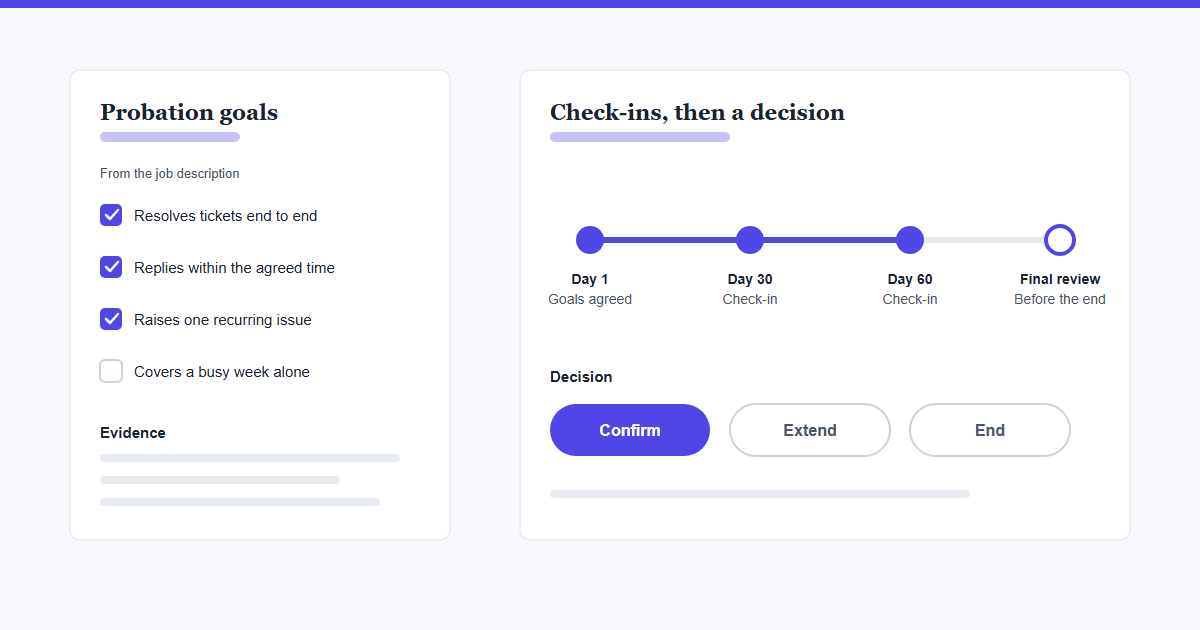
A probation review is the last step of a hire: the point where you decide whether the person is doing the job you described. It is fair when the new hire knew from day one what they would be judged on, heard how they were doing well before the end, and the decision rests on evidence rather than a feeling in the final week. All three come from the same place: the job description.
This guide covers the rules to check first, how to turn the job description into probation goals, the check-ins that prevent surprises, and how to run the final review, with an example you can copy.
1. Check the rules before you set the length
Probation is regulated, and the limits differ by country. In the EU, Directive (EU) 2019/1152 caps a probationary period at six months, unless national law allows longer in exceptional cases. For a fixed-term contract it must be proportionate to the contract, and a renewed contract for the same job gets no new probation.
National rules are often stricter. In the Netherlands, probation must be agreed in writing; it is at most two months on a permanent contract or a fixed-term one of two years or more, at most one month on a fixed-term contract of more than six months and less than two years, and not allowed on contracts of six months or less (Civil Code, book 7, article 652). In Germany, an agreed probation of up to six months lets either side end the contract with two weeks’ notice (BGB section 622).
Takeaway: check your country’s rules and any collective agreement, put the length in the contract, and plan the review backwards from the last day, not the other way round.
2. Turn the job description into three to five goals
Open the job description and take the responsibilities that decide whether someone can do the job. Each becomes one probation goal, written as what you expect to see by the final review. “Good with customers” is not a goal; “closes routine tickets alone by week eight” is.
If you used an interview scorecard, start from its criteria: they already describe the job in terms you can observe, and reusing them means the person is judged on what they were hired for. Our guide to building an interview scorecard from a job description shows how those criteria are written.
Takeaway: three to five goals, each with the evidence you will look at. Share them in writing in the first week, so the new hire can ask what they mean.
3. Line the goals up with onboarding
A goal is only fair if the person had the chance to reach it. Check each goal against the onboarding plan: nobody can run the queue alone by week eight if their access to the tools arrived in week three. The 30, 60 and 90 day milestones in an onboarding checklist are the natural checkpoints; our 30-60-90 day onboarding checklist explains what belongs in each stage.
With a two-month probation, compress the plan: the decision has to fall before the last day, so the evidence must exist by about week seven.
4. Hold check-ins, not just a verdict
Meet at least once halfway, better at each milestone. Go through the goals one by one: on track, at risk or not yet started, with the evidence so far. Agree what changes before the next check-in, and write down what was said, in a few lines both of you can see.
The rule that makes the final review fair is simple: no surprises. If a goal is at risk, the new hire hears it at the check-in, with time to act. A review that first raises a problem on the last day is a decision made without giving the person the chance the probation was for.
5. Run the final review on time
Hold it about a week before the probation ends, so there is time for notice if you need it. Take each goal, look at the evidence, and rate it simply: met, or not yet met. Then decide one of three things:
- Confirm. The goals are met; say so in writing and set the first goals for the months ahead.
- Extend. Only where your contract and national law allow it, and only with a specific gap and a date. In the Netherlands an agreement that runs past the legal maximum is void, so there is nothing to extend into.
- End. If goals are clearly unmet despite support, decide before the deadline and follow the notice rules that apply. Give the reasons in writing when the person asks.
A worked example: customer support specialist
A permanent contract with a two-month probation. Four goals, taken from the job description, with check-ins at weeks three and six and the final review in week seven:
| Goal | From the job description | By the final review | Evidence |
|---|---|---|---|
| Resolves tickets end to end | Own customer issues from first reply to resolution | Closes routine tickets alone and hands over the rest with notes that need no follow-up questions | Ten closed tickets read with the team lead at each check-in |
| Replies on time | Write clear, friendly replies in the customer's tone | Meets the team's first-reply target on their own queue for the last two weeks | The helpdesk's response-time report for those weeks |
| Spots patterns | Flag recurring issues to the product team | Has raised at least one recurring issue in a short written note | The note, and what the product team did with it |
| Calm under volume | Handle busy periods without losing quality | Has run the queue through one busy day with the lead only as backup | The lead's notes from that day |
At the week-three check-in, “calm under volume” is not started yet, so the lead schedules the busy day for week five. By week seven all four goals have evidence, and the review confirms the hire.
Keep the record
Keep the goals, the check-in notes and the final review together in the employee’s file. They are personal data, so write them as if the employee will read them, because they may ask to, and keep them only as long as your retention policy says. If you ever need to show which goals were agreed at the start and that they were not changed later, a sealing service such as XSeal can timestamp the document when both of you sign it.
Start with a clear job description
Every step above leans on the job description: the goals come from its responsibilities, and the checkpoints from the onboarding plan. StaffGenerator writes both for a role in one pack: a job description with responsibilities, requirements and nice-to-haves separated, an onboarding checklist with 30, 60 and 90 day milestones, and an HR policy. For the job description itself, see how to write a job description, section by section.