 StaffGenerator
Preboarding: before a new hire's first day
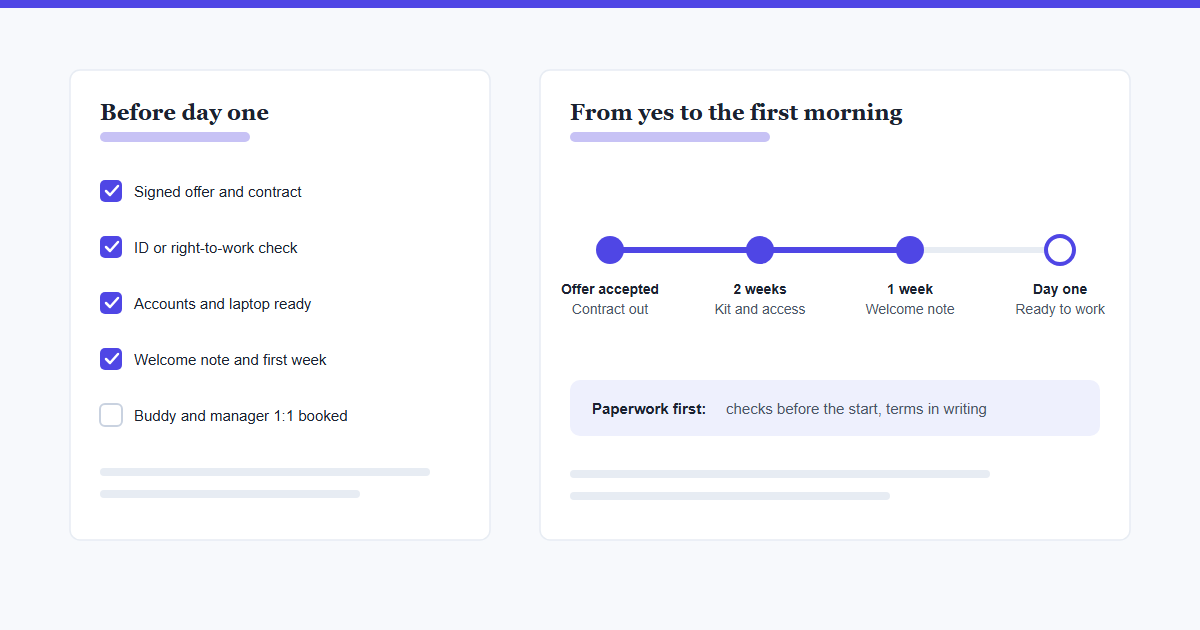
Preboarding is everything that happens between “offer accepted” and the new hire’s first morning: the contract and the legal checks, the laptop and the accounts, and the first message that tells them what to expect. Done well, the first day starts with work that matters. Done badly, it is spent waiting for a password while paperwork that had a legal deadline is still missing.
This guide gives you a timeline for the weeks before the start date, the paperwork deadlines in the US, the UK, the Netherlands and the EU, and the mistakes that most often spoil a first day.
Why the time before day one matters
Two things happen in this window. The first is administrative: some checks must be finished before the person starts or within days of it, and missing them is the employer’s problem, not the new hire’s. The second is personal: someone who has resigned from another job is deciding whether they made the right choice. A short, organised preboarding answers both: the paperwork is done, and the new hire arrives knowing where to go, who they will meet and what their first week looks like.
A preboarding timeline
| When | What | Who |
|---|---|---|
| Offer accepted | Send the signed offer and contract; confirm start date, hours and place of work; ask for the documents payroll and the legal checks need | HR or the hiring manager |
| Two weeks before | Order the laptop and equipment, request accounts and building access, pick an onboarding buddy, plan the first week | Manager, IT, facilities |
| The week before | Send a welcome note with first-day logistics and the first-week schedule; check every account and device works | Manager |
| The day before | Last check: calendar invites sent, desk or remote setup ready, buddy reminded | Manager and buddy |
Takeaway: anything that needs another team, such as hardware, accounts and building access, starts the day the offer is accepted, not the week before.
The paperwork, and its deadlines
The rules depend on where the person works, so check the official guidance for your country before relying on any summary. These are the deadlines that most often catch small employers out:
- United States. The employee completes Section 1 of Form I-9 no later than the first day of work, and may do it any time after accepting the offer. The employer completes Section 2 within three business days of the start date.
- United Kingdom. The right to work check must be completed before the person starts work, using a manual document check, the Home Office online service or a certified digital verification provider. If it cannot be done in time, the start date should wait.
- Netherlands. The employer must establish the employee’s identity before they start work and keep a clear copy of a valid identity document with the payroll records.
- European Union. Under Directive (EU) 2019/1152, the core terms of the job, including the parties, the place of work, the job title or description, the start date, pay and working time, must be given to the worker in writing no later than the seventh calendar day after they start; the remaining information follows within a month. Sending a complete contract before day one covers this comfortably.
Keep the signed contract and the written terms together in one place. If there is ever a question about which version both sides agreed to, a sealing service such as XSeal can timestamp the signed PDF so it is clear it has not changed since.
Set up everything they need to work
The most visible preboarding failure is a new hire who cannot log in. Request accounts and order equipment as soon as the offer is accepted, then check in the week before that everything actually works: the email account, the tools the role uses every day, building or VPN access, and the password manager and two-factor setup your security policy expects. If the role handles customer or personal data, make sure the relevant policies are ready to share; our guide to the HR policies every small business needs lists the essentials.
Make them feel expected
A short welcome note from the manager, sent in the week before the start, should answer:
- Where to go and at what time on the first morning, or which link to join if they are remote.
- Who they will meet in the first week, and who their onboarding buddy is.
- What the first week looks like, at the level of a simple schedule.
- Anything they need to bring, such as identity documents for the checks above.
Keep in touch without asking for work. One or two friendly messages between the offer and the start date are enough; reading lists, tasks or meetings before the contract begins blur the line between preboarding and unpaid work.
Common preboarding mistakes
- Saving all the paperwork for the first morning, so day one is spent on forms.
- Ordering the laptop the week before, when delivery or setup takes longer than that.
- Silence between the signed offer and the start date.
- No time in the manager’s calendar for the first week.
- A role nobody has written down, so the first conversation is about what the job is; start from a complete job description instead.
Put it on a checklist
Preboarding works when it is the same every time, and that means a written checklist rather than memory. StaffGenerator drafts an onboarding checklist for any role that starts with exactly this stage: send the signed offer, contract and compliance paperwork; provision accounts, email and hardware so everything works on day one; share a welcome note, the first-week schedule and who they will meet; and assign an onboarding buddy and a first one-to-one with the manager. The same pack covers day one, the first week and the first 90 days, which our 30-60-90 day onboarding checklist explains in detail.