 StaffGenerator
Job ad vs job description: what goes where
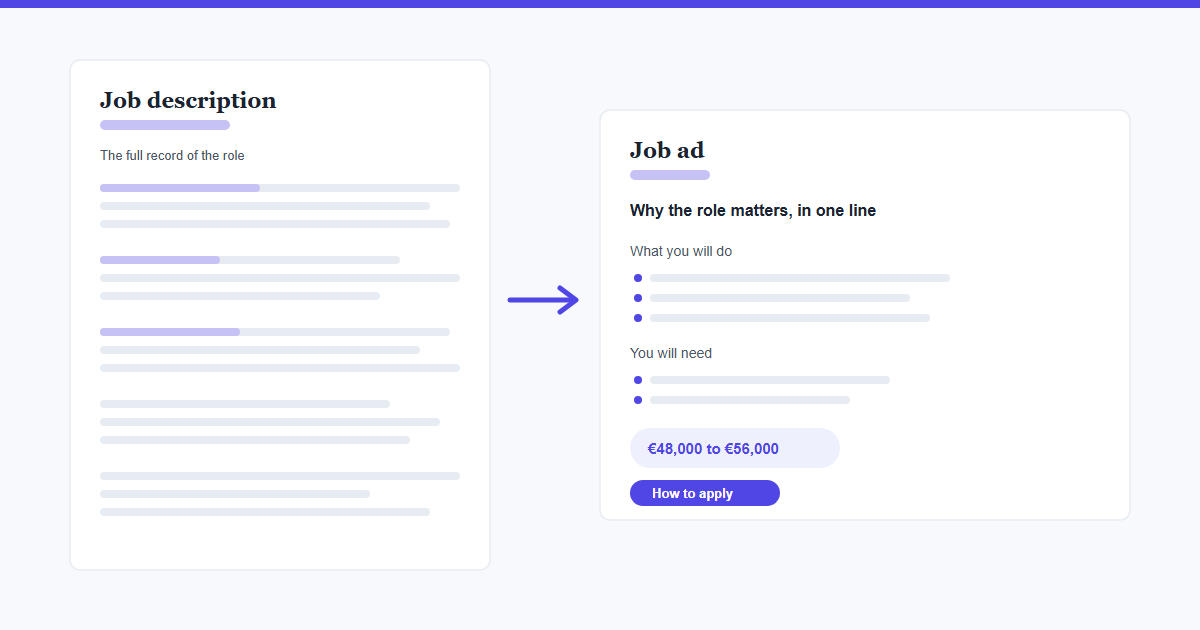
Job ad vs job description: the two get mixed up because they describe the same role, but they do different jobs. The job description is the full record of the role, written for the people who hire, manage and onboard. The job ad is a short pitch, written for someone who has never heard of you and will decide in a minute whether to read on. Pasting one into the place of the other is the most common reason a good role gets few good applicants.
This guide sets out what belongs in each, how to turn a job description into an ad without losing anything that matters, and how to keep the two in step.
Job ad vs job description: the short version
| Job description | Job ad | |
|---|---|---|
| Job | Defines the role: what it is for, what it covers, what it takes | Gets the right people to apply |
| Reader | The hiring manager, interviewers, the new hire, HR | Someone scrolling a job board who has never heard of you |
| Length | As long as the role needs | Short enough to read on a phone in a minute or two |
| Tone | Precise and neutral | Direct and specific about why the job is worth having |
| Lives in | Your files, for as long as the role exists | Job boards and your careers page, while the vacancy is open |
Takeaway: write the job description first. The ad is a selection from it, never the other way round, so the ad cannot promise something the role does not include.
What the job description is for
The job description is the reference everyone comes back to. Interviewers build their questions and scorecards from its requirements; the manager uses its responsibilities to set goals for the first months; the new hire reads it to understand what they were hired to do. It also records decisions you may need to show later: the level, the reporting line, the pay range you set for the role.
That is why it should be complete rather than catchy: responsibilities, requirements and nice-to-haves kept apart, the working pattern, the level and who the role reports to. Our guide to writing a job description, section by section covers each part.
What the job ad is for
The ad has one job: get the right people to apply, and help the wrong people decide not to. A candidate scanning a job board sees the title and the first lines before deciding whether to open the rest, so the opening has to say what the work is and why it matters, in plain words. Everything after that answers the questions a candidate asks before applying: what will I actually do, do I qualify, what does it pay, where and how do I work, and what happens after I apply.
Takeaway: if a sentence does not help someone decide whether to apply, it belongs in the job description, not the ad.
Turning a job description into a job ad
- Open with the work. One or two sentences on what the person will do and why it matters to the team or the customer. Leave the company history for later, or out.
- Pick the outcomes, not the whole list. Take the four to six responsibilities that fill most of the week and write each as a result: “Close your own pipeline of mid-size accounts” rather than “responsible for sales activities”.
- Keep only the must-haves. Copy the requirements that truly decide whether someone can do the job and leave the nice-to-haves in the description. A long wish list puts off qualified people who tick most boxes but not all.
- Say what it pays. Put the pay range in the ad. In the EU, applicants are entitled to know it before the interview; our article on what job ads must show under EU pay transparency explains the rules.
- Say where and how. Location, office or remote days, hours if they are fixed, and the contract type.
- Close with the next step. How to apply, what you need from the applicant and what the process looks like after that, so nobody has to guess.
What to leave out of the ad
- Internal grade codes, cost centres and reporting-line detail beyond the team the person joins.
- Full policy text: mention the benefits that matter and link to the rest.
- Vague requirements that filter people for the wrong reasons, such as years of experience where a skill is what counts; our list of job description mistakes that filter out great candidates applies to ads just as much.
Keep the two in step
When the role changes, change the job description first and cut a fresh ad from it. Ads tend to get edited on the job board in a hurry, and after a few rounds they describe a slightly different job from the one you will interview for. Keep a dated copy of each ad you publish next to the job description it came from: if a candidate later asks what the ad promised, or the pay range is questioned, you can show exactly what was online. A sealing service such as XSeal can timestamp that copy so it is clear it was not changed afterwards.
Takeaway: one source, many cuts. The job description is the source; every ad, social post and recruiter brief is a shorter version of it.
Start from a complete job description
A good ad needs a complete job description to cut from. StaffGenerator writes one for any role in seconds, with the responsibilities, requirements and nice-to-haves already separated, so picking the outcomes and the must-haves for the ad is a matter of choosing lines, plus an onboarding checklist and an HR policy for the same role.