 StaffGenerator
Remote work policy: what to include
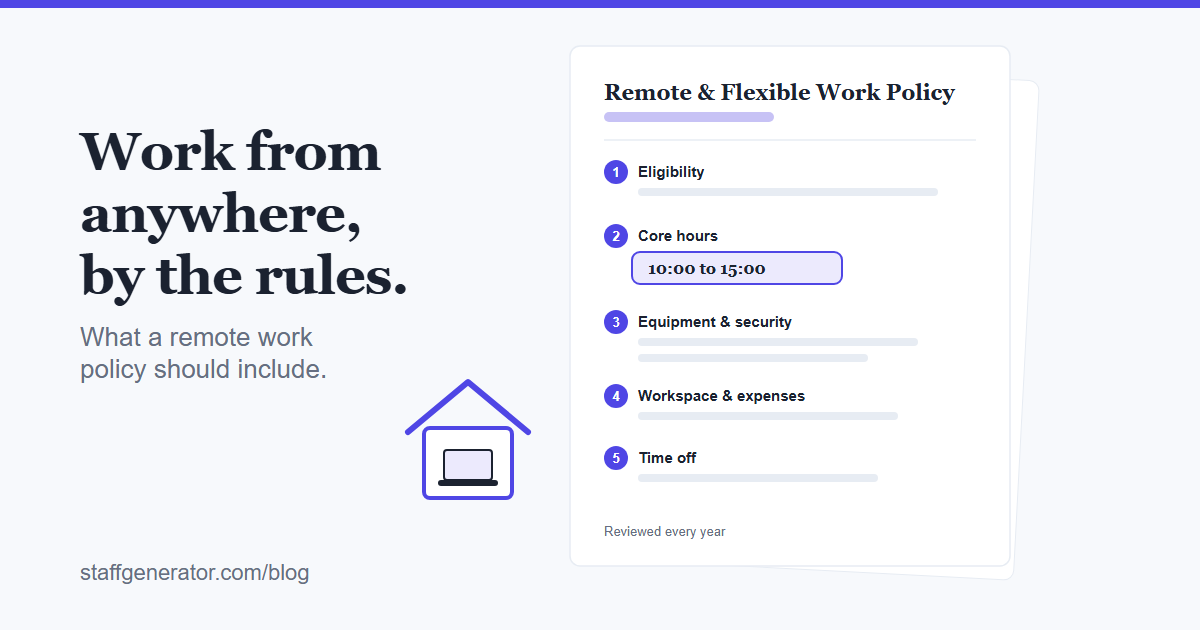
A remote work policy answers the questions every remote or hybrid team runs into sooner or later: who can work from home, when people need to be reachable, who pays for the desk chair, and whether someone can spend a month working from their parents’ house abroad. Without one, those questions get answered case by case, and case by case becomes unfair quickly.
The good news is that a useful remote work policy is short. It does not need to predict every situation; it needs to set clear defaults and say who decides the exceptions. Here is what to include, in the order a new hire will look for it.
1. Eligibility: which roles and how much
Start by saying who the policy covers and what “remote” means for you. Fully remote, hybrid with set office days, or remote-friendly with an office for those who want one are different promises. Name the roles that need to be on site, such as front desk or warehouse work, and say why, so the rule reads as a fact about the job rather than a judgement about the person. If remote work needs a manager’s approval, say who approves it and how quickly.
2. Core hours and availability
Flexible hours work best with a short window when everyone is reachable. A common pattern is core collaboration hours, for example 10:00 to 15:00 in the team’s time zone, with the rest of the day planned by each person. Add what “reachable” means: a reply to messages within a few hours, a calendar that shows when someone is away, and a clear way to signal focus time. Teams spread across time zones should say which zone the core hours follow.
3. Equipment and security
Say what the company provides (a laptop, a monitor, a headset) and what people are expected to look after themselves, such as a reliable internet connection. Then set the security basics that matter most at home: encrypted devices, a password manager, two-factor authentication on work accounts, and no customer or employee data on personal devices. These few lines prevent the incidents that hurt most, and they are much easier to follow than a long IT handbook nobody reads.
4. Workspace, health and expenses
A remote work policy should cover the physical side too. Ask people to keep a safe, workable space and say what you reimburse: a one-off home office budget, co-working costs, or a monthly allowance. In many European countries an employer’s health and safety duties also reach the home workstation, so check what applies where your people work and describe how someone asks for a proper chair or screen.
5. Working from another country
This is the section most policies forget and the one with the biggest consequences. Working from abroad, even for a few weeks, can affect tax, social security and employment law for both the employee and the company. Set a clear rule: either a short yearly allowance for working abroad with notice, or approval case by case. Ask your adviser what limits apply to your countries before you choose the number.
6. Time off and switching off
Remote work is not a reason to skip holidays or answer messages at 22:00. Say plainly that time off is booked as normal, that people disconnect fully when they take it, and that being online outside agreed hours is not expected. Managers set the tone here, so say what you expect of them too.
7. Meetings and written communication
Remote teams run on writing. Say where decisions are recorded, which channel is for urgent questions and which is for everything else, and when a call beats a long thread. Keep recurring meetings inside core hours, share an agenda beforehand and the outcome afterwards, so colleagues in other time zones or on leave can catch up without a meeting about the meeting.
8. Review and ownership
End with who owns the policy and when it is reviewed, at least once a year. Put the date of the current version at the top. When the policy changes, tell people what changed rather than re-sending the whole document. If you ever need to show which version an employee received, keep each published version on record; XSeal’s guide on proving which version of a document you sent explains a simple way to do that.
A short example
Put together, the core of a remote work policy can fit on one page:
Eligibility. Roles are remote-friendly unless the job description says otherwise. Hours. Core hours are 10:00 to 15:00 in your team’s time zone; plan the rest of your day and keep your calendar current. Equipment. We provide a laptop and screen; devices are encrypted, and work accounts use a password manager and two-factor authentication. Expenses. A home office budget once, co-working on request. Abroad. Up to four weeks a year with two weeks’ notice. Time off. Booked as normal; switch off fully. Review. Every October, owned by the People team.
Your numbers will differ. What matters is that each line is a decision someone made once, so nobody has to negotiate it again. For the other policies a growing team needs, see our list of HR policies every small business needs before its 10th hire, and our guide to standardising HR documents as you grow.
Start from a draft
StaffGenerator writes an HR policy with every staffing pack. For product, design, sales and marketing roles that policy is a Remote & Flexible Work Policy covering eligibility, core hours, availability, equipment and security, workspace and expenses, and time off, ready to edit with your own numbers and saved with the job description and onboarding checklist for the role.